

Remember the little padlock icon that used to feel like a big deal? Back when “https” first started showing up in browser bars, nobody ripped out the internet and rebuilt it from scratch. Engineers just bolted a security layer on top of the open protocol everyone already used. Funny enough, that tiny bit of internet history is quietly becoming the best explanation anyone has offered for why Wall Street chose Ethereum over building something proprietary from the ground up.
Sounds almost too simple, right? Yet the simplicity is exactly the point.
The Analogy That Started It All
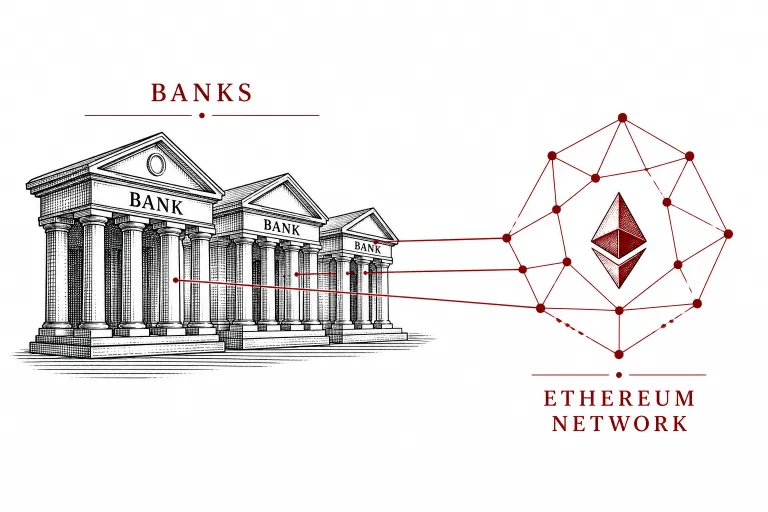
A thread making the rounds recently boiled the whole debate down to one clean comparison. Ethereum plays the role of HTTP, the open base layer of the internet, while permissioned or private layers play the role of HTTPS, the security wrapper built on top. Nobody needed to change the internet to make it secure, developers just added a layer. That’s essentially the blueprint behind why Wall Street chose Ethereum instead of reinventing blockchain infrastructure from scratch.
Here’s the part that makes the analogy click. HTTPS didn’t replace HTTP, it extended it. Traffic still flows over the same underlying protocol, just wrapped in encryption. Ethereum’s layer-2 networks work in a strikingly similar way, settling activity back onto the base chain while adding whatever permissions, privacy, or compliance features a bank actually needs.
Why Building a Private Blockchain Never Made Sense
Picture a bank spending years and untold millions building its own blockchain from scratch, only to end up with a network nobody outside the bank wants to touch. That’s the trap plenty of financial institutions fell into a decade ago, and most of those private chains quietly died from lack of participants. A blockchain without a network effect is just an expensive database with extra steps. Public infrastructure solves that problem instantly. Why Wall Street chose Ethereum instead of a walled garden comes down to liquidity, developers, and existing infrastructure that already works. Building alone means building an island. Building on Ethereum means plugging into an ocean.
The Institutions Actually Doing It
Talk is cheap in crypto, so it helps that the receipts are public. BlackRock launched a tokenized fund on Ethereum. JPMorgan runs blockchain-based settlement infrastructure that touches Ethereum-compatible rails. Franklin Templeton and UBS have both experimented with tokenized funds settling on Ethereum’s public infrastructure too. None of these institutions are exactly known for reckless experimentation, and that’s precisely what makes the pattern worth paying attention to. Reading the tea leaves isn’t hard here. Why Wall Street chose Ethereum stops being a mystery once you notice that regulated giants keep landing on the same base layer independently of one another. Coincidences don’t usually repeat themselves that consistently among competitors who otherwise refuse to agree on anything.
Permission Without Reinventing the Wheel
Banks obviously can’t just dump customer transactions onto a fully public ledger and call it a day. Compliance teams would have a collective panic attack. Layer-2 networks and permissioned sub-layers solve that by adding the equivalent of an HTTPS wrapper, letting institutions control who sees what while still settling value back to Ethereum’s base layer. Ethereum.org describes layer-2 networks as scaling solutions that inherit security from the base chain while offering flexibility on top, which is basically the technical version of the HTTP and HTTPS story. Security and openness aren’t opposites here, they’re stacked on top of each other like floors in a building. Why Wall Street chose Ethereum makes a lot more sense once that stacking becomes obvious instead of abstract.
Liquidity Is the Quiet Deciding Factor
Nobody wants to admit that liquidity is boring, but liquidity is genuinely the boring reason so much institutional capital keeps landing in the same place. Ethereum already hosts the deepest pools of decentralized finance activity, the largest developer community, and the most battle-tested smart contract infrastructure in the industry. Skipping all of that to build a private alternative would be like opening a store on an island nobody visits instead of renting space on Main Street. Coverage from outlets like CoinDesk has tracked this liquidity magnet effect for years, long before institutional adoption became a mainstream headline. Why Wall Street chose Ethereum, in the end, mirrors why any serious business chooses to set up shop where the customers already are instead of hoping customers eventually show up somewhere new.
What Retail Investors Get Out of This
Institutional adoption sounds like a story about hedge funds and trading desks, but the ripple effects reach regular investors too. Tokenized funds settling on Ethereum’s public infrastructure mean smaller investors eventually get access to products that used to require six-figure minimums and a private banker on speed dial. Why Wall Street chose Ethereum matters to someone with a modest brokerage account for the same reason the interstate highway system mattered to someone who never worked in shipping. Infrastructure built for giants tends to lower costs for everyone else riding on the same rails. Settlement speed is another underrated benefit. Traditional securities settlement can take days to clear, tying up capital and creating counterparty risk along the way. Blockchain-based settlement on Ethereum’s infrastructure can compress that timeline dramatically, and faster settlement means less friction for buyers and sellers on both ends of a trade. Small improvements like that rarely make headlines, but they add up across millions of transactions a year.
Not a Perfect Fairy Tale
Skepticism deserves a seat here too, because pretending everything is flawless would be dishonest. Gas fees still spike during busy periods, layer-2 fragmentation creates its own headaches, and regulatory clarity around tokenized securities is still very much a work in progress in plenty of jurisdictions. Why Wall Street chose Ethereum doesn’t mean every institutional experiment on it succeeds cleanly or scales overnight. Competing chains keep pitching themselves as faster or cheaper alternatives too, and some of those pitches genuinely have merit for specific use cases. Ethereum isn’t winning by default, it’s winning by accumulating enough infrastructure, liquidity, and developer trust that switching costs keep climbing for anyone tempted to leave.
A Quick Reality Check on Timelines
None of this happened overnight, and pretending otherwise does a disservice to how genuinely slow institutional adoption actually moves. Legal teams at banks the size of JPMorgan don’t approve blockchain settlement pilots after a single enthusiastic meeting. Years of compliance review, pilot programs, and quiet internal testing usually precede any public announcement, and most of that groundwork never makes the news at all. Patience matters here too. Retail crypto culture moves at meme speed, while institutional finance moves at the speed of risk committees and legal sign-off. Comparing the two timelines side by side explains a lot of the disconnect between crypto Twitter excitement and the far more measured pace of actual bank adoption. Neither pace is wrong exactly, they’re just built for different audiences with very different tolerances for risk.

The Bigger Pattern Worth Watching
Zoom out far enough and a familiar shape appears. Open protocols tend to outlast closed ones, not because closed systems are technically inferior, but because open systems accumulate participants faster than anyone can compete with alone. HTTP won the internet the same way. Ethereum appears to be winning institutional finance for strikingly similar reasons. Watching traditional finance slowly gravitate toward the same base layer, again and again, feels less like a trend and more like a slow-motion consensus forming in real time. Why Wall Street chose Ethereum might end up being one of those decisions that looks obvious in hindsight, the same way building websites on HTTP eventually stopped being a debate at all.
Final Thoughts
Big banks rarely move fast, and rarely move together, unless the underlying logic is genuinely compelling. Why Wall Street chose Ethereum comes down to something refreshingly unglamorous: an open base layer, a security wrapper built on top instead of a system rebuilt from scratch, and liquidity too large to ignore. History already ran this experiment once with the internet, and the ending turned out pretty well. For more breakdowns on how institutional finance keeps colliding with crypto infrastructure, check out Ethpublic.com.