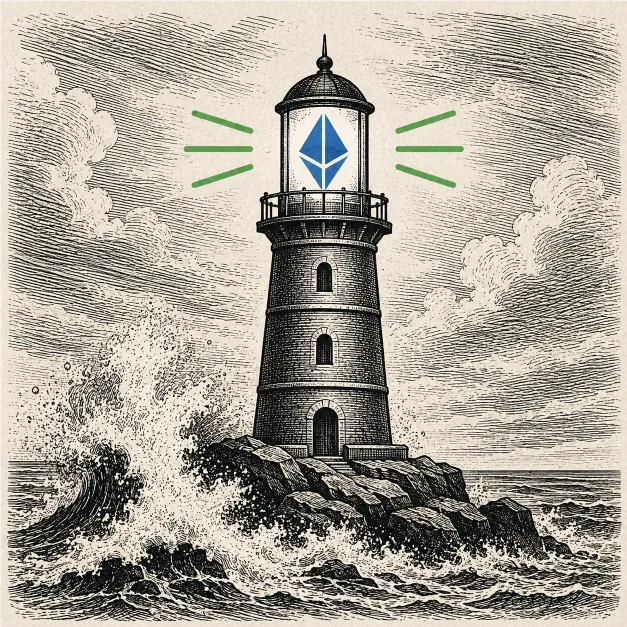
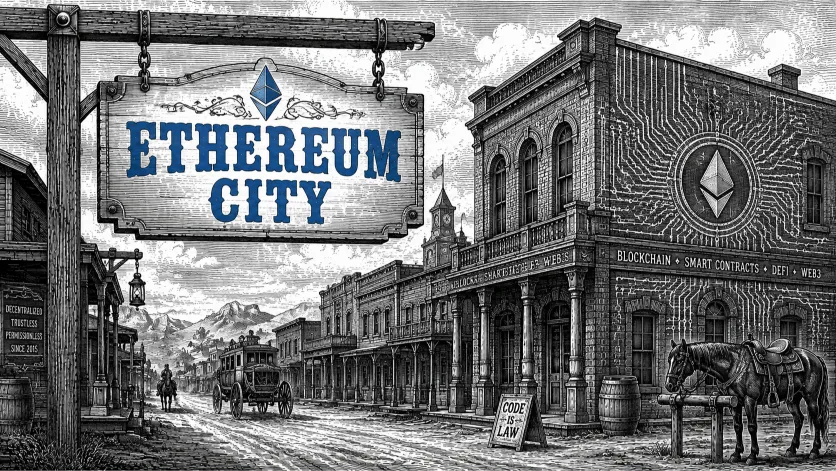
Picture a dusty frontier town in 1875. No sheriff. Gold in the hills. Opportunity everywhere and just as many con artists as prospectors. Like Dodge City, that rough frontier settlement quickly grows into Ethereum City, a bustling frontier city with a courthouse, railroad, businesses, and new districts stretching beyond the original streets. Surprisingly, that’s one of the best ways to understand today’s Ethereum and the blockchain.
Newcomers show up daily, drawn by stories of fortunes made overnight. Some strike real gold, silver or even copper. Others lose everything to a stranger with a smooth pitch and an empty promise. Sound familiar? Welcome to the blockchain wild west. Population: everyone with an internet connection and a little curiosity.
Blockchain Explained: What Is The Blockchain, Anyway?
Strip away the jargon and a blockchain is just a shared notebook that nobody owns and everybody can check. Every transaction gets written down, copied across thousands of computers, and locked in place so nobody can quietly erase a page later. No bank vault, no single company holding the master copy, just a distributed ledger everyone agrees on.
Gold, Silver, and Copper: The Claims That Started It All
Blockchain itself is the river, the raw technology that made all of this possible in the first place.
Bitcoin is the gold everyone found in it first, the original strike that pulled prospectors west and proved the whole territory was worth exploring back in 2009. No real city grew up around Bitcoin’s claim. It stayed the gold itself, valuable, scarce, mostly just dug up and stored away.
Ethereum turned out to be the silver vein a little further upstream, a different metal with different uses. If you’ve been looking for Ethereum explained in plain English, think of Ethereum as the city built on top of blockchain technology. Unlike Bitcoin’s claim, an actual city grew, with real streets, real businesses, and rules enforced by code instead of a badge and a gun. Smart contracts, explained in the simplest terms, are self-executing agreements written in code that runs exactly as intended, with zero need for a middleman. Smart contracts became Ethereum’s railroad, connecting scattered outposts into something resembling an actual economy. Lending, trading, gaming, digital ownership, all of it started building on Ethereum’s rails.
Ethereum’s own downtown, what people call Layer 1, is where the city’s original laws live. Every deal gets filed downtown, where today’s validators keep the courthouse records secure. Trusted ground, but crowded. Building anything downtown gets expensive fast once enough people show up wanting the same street corner. So the city grew an outer settlement, Ethereum Layer 2. Base, Arbitrum, and Optimism, known as Ethereum Layer 2 networks, sit just outside the city, offering cheaper land and faster building permits. But here’s the part that keeps the whole system honest: Every deed signed in an Ethereum Layer 2 settlement still gets filed back at the downtown Ethereum Layer 1 courthouse. Those settlements move fast, but Ethereum’s own Layer 1 is still the record that actually counts. Ethereum Layer 2 explained simply: imagine neighborhoods built just outside the busy downtown courthouse. They move faster and cost less, but every important record still gets filed back at Ethereum’s Layer 1 courthouse.

Every city eventually develops landmarks. Ethereum City has a courthouse where every transaction is permanently recorded, a general store where coins are traded, a gas depot that keeps commerce moving, a validator bank that secures the city, a DAO Hall where citizens vote, and a railroad connecting Layer 2 settlements back to downtown. The more you learn the city, the easier blockchain becomes to navigate.
Further out, other prospectors struck copper. Solana built its own town around that find, smaller than Ethereum City and younger too, but genuinely busy in its own right. Copper may not command the price of gold or silver, but every growing settlement depends on it, which is exactly the reputation Solana has built for itself.
DAOs: City Councils Without a Mayor
Every frontier settlement eventually needed some form of self-governance, usually a council of settlers voting on shared decisions since no distant government could respond fast enough to matter. DAOs, or decentralized autonomous organizations, do exactly this on-chain.
A DAO lets token holders vote directly on decisions, from how treasury funds get spent to which upgrades a protocol should adopt. No CEO, no board of directors quietly making calls behind closed doors. Just code and community, functioning like a vigilance committee that actually shows its work.
Does this always run smoothly? Not even close. Think of it as a city council where everyone gets a vote, but not everyone actually shows up. Voter turnout in DAOs is often embarrassingly low, and a handful of large token holders can sometimes steer outcomes more than the philosophy of decentralization would suggest. Still, the experiment matters, and it’s one of the more genuinely novel ideas to come out of the blockchain wild west so far.
Selling Shovels in the Digital Gold Rush
Here’s a detail most gold rush stories skip: the people who reliably got rich weren’t usually the ones panning the rivers. Levi Strauss never struck gold in his life, he made a fortune selling durable pants to miners who did. The real money often sat one step removed from the actual digging.
Crypto works the same way. Whether a prospector was chasing gold (BTC), silver (Ethereum), or copper (Solana), everyone still needed the same basic tools. Wallets are the digital pan, the first thing every prospector needs before touching anything valuable. MetaMask, Ledger, and similar tools exist purely to hold and move the gold safely, and companies behind them profit steadily whether any individual user strikes it rich or not.
Exchanges became the general store where every prospector eventually stopped. Coinbase and Kraken make money on every transaction that passes through, regardless of whether the broader market goes up or down that week.
Block explorers like Etherscan act as the surveyor’s map, letting anyone check exactly what’s happening on a claim before trusting it. And DeFi protocols work more like sluice boxes and processing equipment, tools built to extract additional value from gold prospectors already hold, rather than finding new deposits outright.
Worth remembering next time a flashy new coin promises overnight riches: the steadiest money in any gold rush usually goes to whoever’s selling the shovels, not whoever’s swinging one.
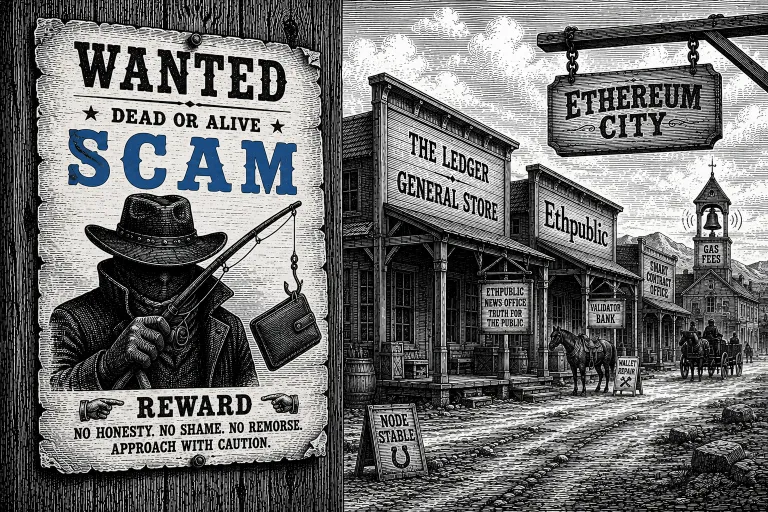
Crypto Scams: The Outlaws Riding Through Town
Every boomtown attracted outlaws because every fortune attracted a thief. No frontier story skips the outlaws, and crypto has no shortage of them. Fake wallet verification scams flood social media daily, promising urgent account fixes while quietly draining real funds. Rug pulls lure investors into projects with flashy websites and zero substance, then vanish overnight with the money.
Phishing sites clone real exchanges pixel for pixel. Romance scams pivot into crypto “investment advice” that ends in an empty wallet. The blockchain wild west earns its outlaw reputation honestly, and pretending otherwise does nobody any favors.
Here’s the twist though: the technology underneath isn’t the villain. A stagecoach robbery doesn’t mean roads themselves are dangerous. Blockchain transactions are actually more transparent than most traditional finance, every movement sits on a public ledger anyone can inspect. The danger usually comes from human deception layered on top, not the underlying rails.
Where’s The Sheriff?
There isn’t one, not really. Not one that lives on the blockchain, and there probably never will be. Validators only check that a transaction is signed correctly, not whether the person behind it is lying. Give the network the power to reverse a “bad” transaction, and eventually someone could reverse any transaction they don’t like, which defeats the entire point of building a city nobody controls in the first place.
But a sheriff does exist, he just doesn’t live in the city. Agencies like the FBI, the Secret Service, and the Department of Justice’s own cryptocurrency crimes unit investigate blockchain fraud the same way they’d investigate any other financial crime, using firms like Chainalysis and TRM Labs to trace stolen funds across the public ledger. Ironically, that public ledger makes tracing easier than cash ever was. Every movement stays visible forever, right up until someone tries to cash out through an exchange, which is usually where the trail actually leads to an arrest.
Real prosecutions do happen. The FBI clawed back a chunk of the Colonial Pipeline ransom in 2021 by tracing it on-chain. High-profile fraud cases have landed people in federal prison. But for the average person who loses a few hundred dollars to a fake wallet verification scam, the honest odds of that sheriff riding in and getting the money back are low. Out here, law enforcement mostly chases the biggest outlaws. Everyone else is left in the cloud of dust the scammers leave behind.
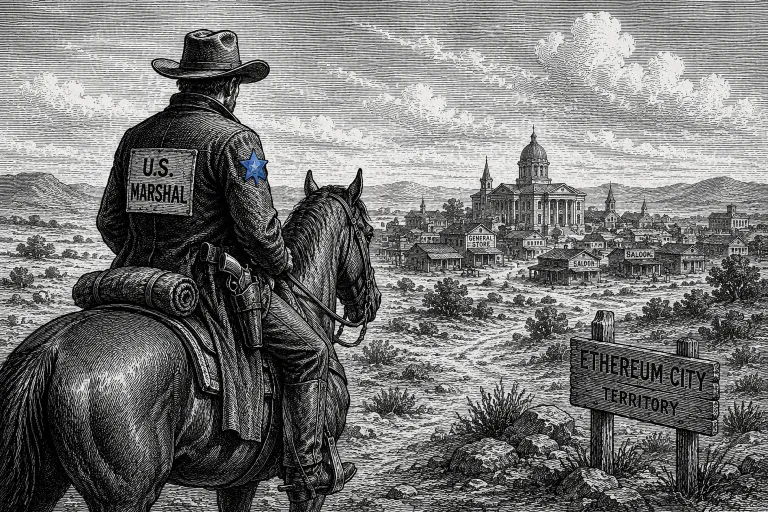
Validators: Close To A Panel Of Notaries
Validators are a rotating panel of witnesses who check that every deed is signed correctly before it gets filed at the courthouse. Enough of them have to agree the paperwork is legitimate before anything becomes official, which is exactly what keeps forged transactions out of the record in the first place. But once a deed is filed, it’s permanent, whether the underlying deal was honest or not. Nobody’s riding out after the fact to chase down the scammer or claw the money back. That’s the real reason outlaws in this territory operate so freely: the law here only checks paperwork on the way in and doesn’t patrol the streets looking for trouble once the ink is already dry.
The CLARITY Act Is Basically Admission Into The Union
Every frontier territory eventually faces the same question: does it stay self-governed, or does the federal government step in and formalize the rules? Crypto is living through exactly that moment right now with the CLARITY Act, a bill working through Congress that would finally draw clear regulatory lines around digital assets.
Passage would mean clearer rules for exchanges, clearer protections for everyday holders, and less of the enforcement-by-lawsuit chaos that’s defined crypto regulation for years. Territories eventually become states. Whether that happens smoothly or gets bogged down in political gridlock remains genuinely uncertain, and worth watching closely if the blockchain wild west matters to you at all.
Should You Saddle Up?
Depends entirely on how you ride. Rushing in blind, chasing hype, and skipping basic security precautions is how people lose their shirts in any frontier, digital or otherwise. Moving carefully, learning the actual terrain first, and treating unfamiliar strangers with healthy suspicion tends to work out considerably better.
A few genuinely useful habits: never share a seed phrase with anyone, verify links before clicking, and start small until the mechanics actually make sense. None of this requires becoming a developer or a finance expert. Basic caution goes a remarkably long way out here. Think of this article as a beginner’s guide to Ethereum. Understanding every technical detail isn’t required before safely exploring the city.

Slow the Click Before the Trick
IMPORTANT: Good blockchain security isn’t complicated. Usually it comes down to slowing down, verifying what you’re seeing, and refusing to let urgency make decisions for you. Verifying a link takes seconds, but most people skip it entirely because scammers are betting on urgency winning out over caution. The single most reliable habit: never click a link sent through a DM, email or social media post when money or a wallet is involved. Type the address yourself instead, or use a bookmark saved from the real site earlier. If clicking feels unavoidable, hover over the link first (or press and hold on mobile) to preview the actual destination before committing to it, and read that domain carefully, character by character. Scammers rely on lookalike tricks like swapping a lowercase “l” for a capital “I” or burying the real destination behind a fake-looking subdomain. A padlock icon means the connection is encrypted, nothing more. Scammers get those too, so it’s not proof of legitimacy on its own. When in doubt, check the company’s official account directly, typed in manually, rather than clicking from wherever the suspicious message sent you. None of this takes long. The only real requirement is doing it before clicking, not after.
For broader context on how digital fraud patterns get tracked and studied, the Cybersecurity and Infrastructure Security Agency publishes ongoing advisories worth a look, even for readers outside the crypto space entirely.
Ethpublic, The Newspaper of Ethereum City
Some frontier towns grew into cities and eventually got a newspaper. Most of them didn’t last long. Historians who’ve studied the business of frontier journalism found that only a minority survived more than a few years, and trust alone rarely explains why the winners won.
Dodge City’s first attempt proves the point. The Dodge City Messenger launched in February 1874, when A.W. Moore hauled printing equipment west from a paper he’d already started in Holton, Kansas. It folded within a year. The Dodge City Times, founded in 1876 by 22-year-old Walter Shinn, lasted for decades instead.
The difference usually came down to business fundamentals, not just good writing. Papers that survived generally had a growing population behind them, enough new settlers and businesses to support real subscriber and advertiser numbers. Advertising revenue mattered more than subscriptions in most cases, general stores, hotels, saloons, lawyers, and land companies all paid to run notices. Legal notices helped too. Governments required land claims, mining claims, and court notices to run in local papers, which gave many editors a steady, boring, but reliable income stream. And the owners who lasted tended to run their business carefully, watching expenses and actually collecting what they were owed.
The papers that failed usually did so for reasons that had nothing to do with the quality of the reporting. A mining boom went bust and the town emptied out. A railroad line got built ten miles away instead, and the whole population simply left. Presses, paper, and ink were expensive to ship into remote territory, and a badly managed paper could bury itself in debt long before readership ever became the real problem.
Here’s the detail worth sitting with: many frontier papers weren’t just reporting news, they were selling the town itself. Editors wrote glowing coverage of local mines and farms because attracting new settlers and investors kept both the town and the paper alive. Optimism was practically part of the business model, whether the facts fully supported it or not.
Ethpublic is aiming for the version that lasted for the right reasons. Early frontier papers helped settlers navigate a confusing, unfamiliar territory with real, honest information, not just boosterism dressed up as news. That’s the job this site is trying to do for Ethereum: explain a genuinely new frontier in plain English, warn people about the outlaws working it, and skip the part where optimism gets sold as fact just because it’s good for business.
The Bottom Line
Every frontier eventually gets tamed, or at least mapped. Crypto is somewhere in the middle of that arc right now, still wild in places, increasingly structured in others. Ethereum didn’t tame the blockchain wild west. It built a city within it, complete with its own institutions, marketplaces, and rules enforced by code.
Whether you’re panning for gold, building a storefront, or just curious what all the fuss is about, the best horse you can own out here is named Knowledge. For more plain language breakdowns of what’s really happening out here, ethpublic.com keeps a running map of the territory.