

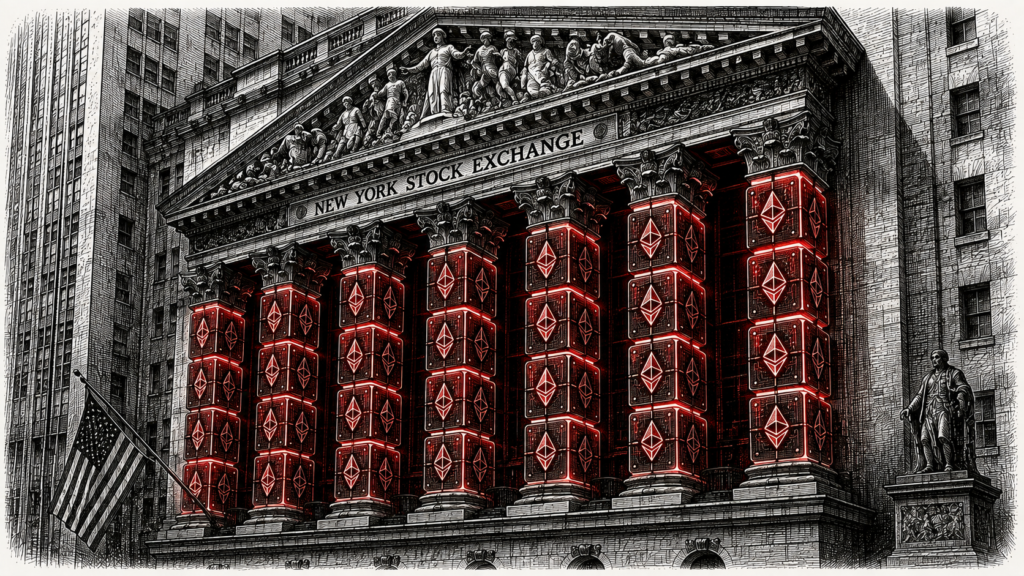
Imagine a trading floor where settlement happens in seconds instead of days, where a bond trade clears itself without a single fax machine or overnight courier involved. Sounds far off? Maybe not. A growing number of banks and asset managers now believe Ethereum could power Wall Street in ways that sounded like science fiction a decade ago, and the early pilots already running suggest they might be onto something real.
Why This Conversation Is Happening Now
Wall Street runs on trust, paperwork, and a small army of intermediaries who each take a cut to make sure everyone gets paid correctly. Costs pile up fast across that chain, and settlement can drag on for two or three business days on a routine stock trade. Frustration with that slowness has been building for years, quietly, in back offices nobody outside finance ever hears about. Executives who once dismissed crypto as a fad now run internal task forces asking a very specific question: could Ethereum power Wall Street’s plumbing better than the systems built in the 1970s?
The Technology Doing the Heavy Lifting
Smart contracts sit at the center of the whole idea. Self-executing code on Ethereum’s network can automatically transfer ownership, trigger a payment, or enforce a bond’s terms the moment conditions are met, no back-office team required to push paper through six departments. Settlement that used to take two days can, in theory, finish in the same block a trade gets confirmed. Big financial institutions have started testing exactly that, running pilot transactions on both public and permissioned versions of the network to see how far the idea can stretch.
Tokenized versions of real assets, from Treasury bonds to money market funds, already exist and trade on Ethereum today. A few asset managers have moved billions of dollars of fund shares onto the chain, quietly, without much fanfare outside financial trade publications. Momentum like that is exactly why so many analysts now argue Ethereum could power Wall Street’s core infrastructure within a decade, not as a replacement for banks, but as the rail underneath them.
What Wall Street Actually Gains
Speed matters, obviously, but cost savings matter just as much to a bank’s bottom line. Cutting out layers of custodians, clearinghouses, and reconciliation teams could save the industry billions of dollars a year, according to estimates from several major consulting firms. Round-the-clock markets become possible too, since a blockchain does not observe holidays or close at 4pm on a Friday. Global investors could theoretically buy a slice of a U.S. Treasury bond at 3am on a Sunday, something that sounds almost absurd under the current system.
Transparency improves as well, and that part gets overlooked a lot in these conversations. Every transaction on a public ledger stays visible and auditable, which cuts down on the kind of quiet errors and disputes that used to take weeks to untangle between two back offices.
Real Examples Already in Motion
BlackRock launched a tokenized fund on Ethereum, giving institutional investors a taste of what on-chain settlement actually looks like in practice. Franklin Templeton runs a similar product, and several European banks have issued digital bonds directly on the network rather than through the traditional syndication process. Reuters has covered a handful of these pilots in detail, and the pattern across all of them looks remarkably consistent: faster settlement, lower fees, and fewer intermediaries standing between a buyer and a seller.
Regulators have taken notice too. Discussions between central banks and private firms about how Ethereum could power Wall Street’s next generation of market infrastructure have moved from closed-door meetings into public comment periods and formal pilot programs over the past couple of years.

The Skeptics Have a Point Too
Not everyone buys the hype, and honestly, some of the skepticism holds up. Regulatory clarity remains patchy at best, with different agencies in different countries drawing different lines around what counts as a security on-chain. Scalability concerns linger as well, even with upgrades that have pushed transaction throughput higher than it used to be. Legacy systems run deep inside every major bank, and ripping out decades-old infrastructure takes years, not months, no matter how promising the new technology looks on a slide deck.
Security also stays front of mind for anyone paying attention. A single smart contract bug can freeze millions of dollars instantly, and audits, while helpful, catch problems only after someone thinks to look for them. Betting an entire settlement system on code that has occasionally failed spectacularly in the past still makes plenty of risk officers nervous, and fairly so.
Where This Actually Goes From Here
Full replacement of Wall Street’s existing rails seems unlikely anytime soon, at least according to most people actually building this stuff. A hybrid model looks far more probable, where traditional finance and blockchain infrastructure run side by side for years before anything fully merges. Even in that more modest scenario, the case that Ethereum could power Wall Street’s back office within the next decade keeps getting stronger every quarter, backed by real pilot data rather than just speculation on a podcast.
Big institutions rarely move fast, but they do move eventually once the economics get hard to ignore. Billions of dollars already sit in tokenized products, and that number keeps climbing month over month. Something is clearly shifting, quietly, underneath the surface of an industry that usually resists change until it has no other choice.
Watching how fast this space evolves gets easier with the right resources close at hand, and for anyone tracking the deeper mechanics behind why Ethereum could power Wall Street’s future, Ethpublic.com keeps a running breakdown of the pilots, partnerships, and technical updates worth knowing about.