Somewhere out there, a guy registered “Joe1987.eth” and probably doesn’t realize he just handed the internet his real first name and the year he was born. Meanwhile his neighbor grabbed “outpost9.eth” and registered it for 20 years, which comes out to a little more than $100, and nobody on earth can tell a single real thing about him from it. That gap between those two choices is basically the entire lesson here. Picking an anonymous but memorable .eth name isn’t complicated once you see the pattern, but almost nobody explains it clearly before people start typing random words into a registrar.
Why Raw Wallet Addresses Fail at the One Job That Matters
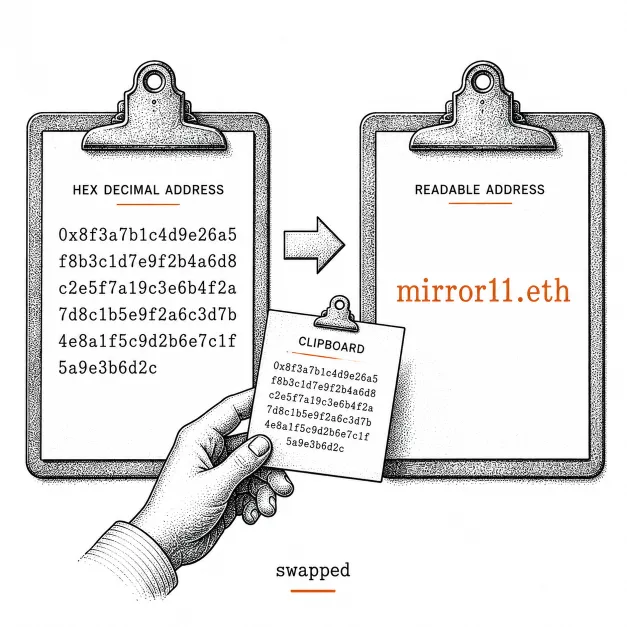
Somebody might reasonably ask why bother with a name at all when a wallet address is already anonymous and copy-paste already solves the typing problem. Fair point on the surface, but a few real failure modes get glossed over here. Copy-paste doesn’t protect against wrong-network or wrong-asset mistakes, since a hex address looks identical no matter what chain or token it’s actually meant for. Copy-paste also doesn’t help when there’s nothing to copy from, someone reads an address over a phone call, texts a screenshot with no selectable text, or hands over a business card. A name like outpost9.eth can be typed from memory or read aloud correctly. A 42-character string can’t. The scarier issue is clipboard-hijacking malware, a real and well-documented attack where malicious software silently detects a copied wallet address and swaps it for the attacker’s address before the paste even happens. Catching a swapped 42-character string by eye is nearly impossible. Catching a swapped short name is far easier, since it’s something a person actively recognizes rather than blindly trusts. An anonymous but memorable .eth name solves the exact problem raw hex addresses create, keeping the privacy while finally making the thing usable and safer for an actual human being. Ethereum.org describes the entire naming service as a way to turn machine-readable identifiers into names people can actually work with, and that description undersells just how big a quality-of-life jump this is once you’ve lived with both versions.
The Sweet Spot Nobody Talks About
Most guides push people toward either ultra-premium three-character names or generic dictionary words, and both routes miss the real target. An anonymous but memorable .eth name lives in a specific, boring, underrated zone: five or more characters, a concrete noun, maybe a number tacked on the end. Cloud8. Outpost9. Harbor7. None of these scream “look at me,” yet all of them stick in someone’s brain after hearing them exactly once. Concrete nouns beat abstract ones every time for stickiness. “Essence” or “vector” slide right out of memory. “Driftwood” or “granite” carve a little mental image and stay put. That’s not marketing fluff, that’s just how human memory happens to work, and it’s the entire secret behind why an anonymous but memorable .eth name feels effortless to recall weeks later.
What Makes a Name Actually Anonymous
Privacy fails in sneaky ways here, and most people don’t notice until it’s too late. Birth years buried in a name, hometown references, a pet’s name paired with a street number, all of these leak real information dressed up as a “random” identifier. A genuinely anonymous but memorable .eth name avoids anything traceable back to a real detail, which means the number tacked onto the end needs to be arbitrary, not a disguised birthday or anniversary. Skip anything tied to a job title, employer, or hobby too specific to your actual life. “Photographer42” narrows down a real person shockingly fast once combined with other on-chain activity. Choosing something evocative but unrelated, like a season, a landscape feature, or an object with zero personal connection, keeps the anonymity intact while still giving the name personality.
Avoiding the Premium Name Trap
Three and four character names get all the headlines because some have sold for over $100,000 on secondary markets, but chasing that territory is a financial trap for anyone just wanting a usable identity. Premium short names carry steep annual renewal costs, and missing a renewal window means losing the name to whoever’s watching the expiry list. An anonymous but memorable .eth name doesn’t need to be short to work, it needs to be distinctive and easy to type correctly. Five-character-plus names run cheap by comparison, often just a few dollars a year, and they dodge the squatter-bait problem entirely since nobody’s circling a random word-plus-number combo waiting to snipe it. Cheap, low-drama, and forgettable to attackers while staying memorable to friends, that combination is exactly the goal.
Registering for the Long Haul
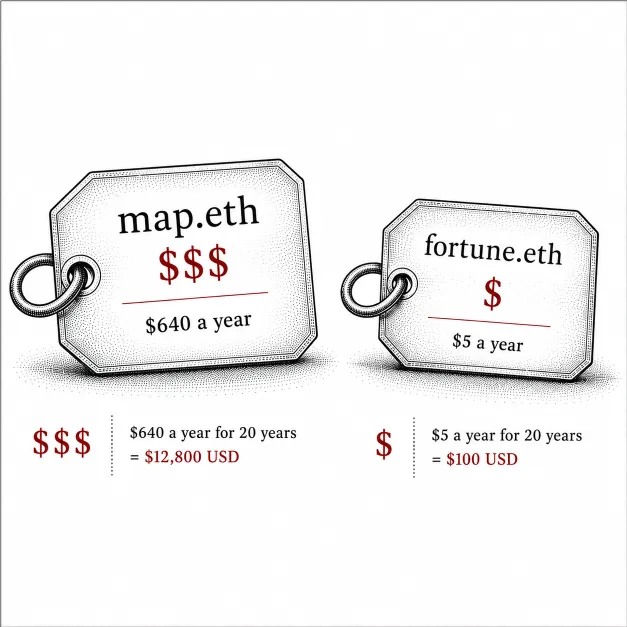
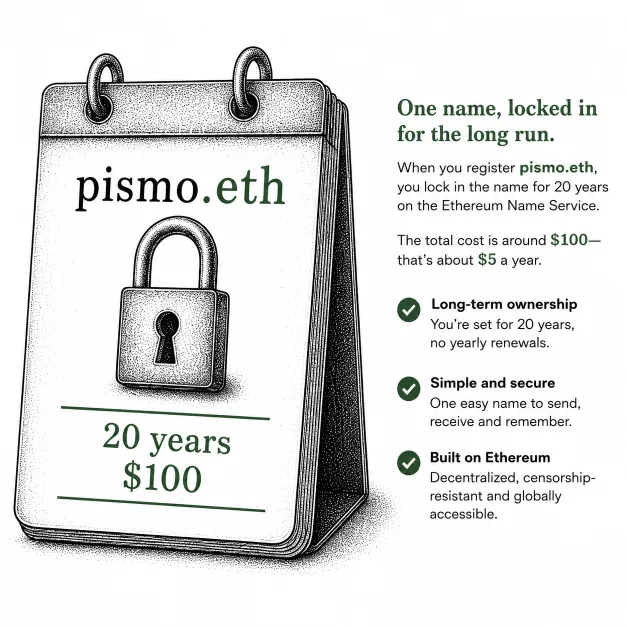
Renewal risk deserves its own warning label. Forget to renew a name tied to years of activity, and someone else can register it the moment the grace period ends, potentially intercepting funds people still send to the old name out of habit. Locking in a registration for the maximum available term, often up to twenty years in a single transaction, sidesteps that entire headache. Here’s the actual math behind that outpost9.eth example from the intro. Five-character-plus names run roughly $5 a year in base registration fees, so twenty years of coverage lands around $100 before gas. Paying once for two decades beats paying annually four different ways. First, one gas payment replaces twenty separate ones, and gas costs add up fast when paid every single year instead of once upfront. Second, a twenty-year registration removes the renewal date from a person’s mental to-do list entirely, no calendar reminder, no risk of a forgotten expiration slipping through the cracks during a busy year. Third, locking in the rate now protects against any future pricing changes the ENS DAO might vote on down the road. Fourth, and most importantly, a twenty-year lock removes the exact window squatters watch for, since there’s no expiration date anywhere close for an opportunist to circle. Paying roughly $100 once for twenty years of a stable identity is about as close to “set it and forget it” as crypto gets. An anonymous but memorable .eth name registered for the long term basically becomes a permanent fixture, which honestly feels like the whole point of picking a name instead of memorizing an address in the first place.
What Happens When You Get It Wrong
Worth spending a minute on the failure cases too, since seeing what goes wrong makes the right approach click faster. Someone registers “davidsmith1988.eth” thinking it looks professional, not realizing it just published a full name and probable birth year to anyone who bothers to look. Someone else grabs a three-letter premium name for a few hundred dollars, forgets the renewal date exists, and wakes up a year later to find a squatter bot already claimed it during the grace period. Both mistakes come from the same root cause: picking a name without thinking through what it reveals or what it costs to maintain. An anonymous but memorable .eth name avoids both traps simultaneously, cheap enough to renew without a second thought, vague enough that a stranger scrolling a block explorer learns absolutely nothing useful about the person behind it.
Testing a Name Before Committing
A quick gut check works better than overthinking this. Say the candidate name out loud to a friend once, then ask them to repeat it back five minutes later without looking. Names that survive that test tend to survive long-term use too. Bonus points if the name still makes sense without any context attached, since a good identity should stand on its own rather than needing an explanation every time someone hears it for the first time. Checking availability takes seconds through the official ENS manager app, and it’s worth searching a handful of variations at once rather than falling in love with a single option that might already be taken. An anonymous but memorable .eth name rarely emerges as the very first idea someone types in, usually it’s the fourth or fifth variation that finally feels right.
A Few Real Examples Worth Studying
Breaking down a handful of solid picks helps make the pattern concrete instead of theoretical. “Lantern3” works because a lantern conjures a specific image without hinting at anything personal, and the number keeps it affordable. “Compass5” leans into direction and navigation without revealing where anyone’s actually headed. “Basalt4” borrows from geology, obscure enough to feel unique, common enough as a word to stay pronounceable. “Switchback9” evokes a mountain trail and reads almost like a trail name hikers give themselves, memorable and a little mysterious at once. None of these names are clever wordplay or inside jokes. Plain, visual, slightly evocative words paired with a random digit, that’s the entire formula behind an anonymous but memorable .eth name that people actually enjoy using instead of one they registered on a whim and later regret.
Where This Actually Gets Used
Skeptics reasonably ask who even needs this. Fair question, and the honest answer isn’t “everyone.” Anyone holding crypto for any reason benefits the moment they need to receive funds without sharing a hex string. Freelancers getting paid internationally benefit from a name that’s easy to communicate over email or a call. Creators building an on-chain presence get a persistent identity a platform can’t quietly delete. Privacy-conscious users get the biggest win of all. An anonymous but memorable .eth name lets someone participate in a public, transparent ledger while keeping their real-world identity completely separate from their on-chain activity, something a bank account or a Venmo handle simply can’t offer.
Final Thoughts
Pick something concrete, pick something forgettable to strangers but sticky to friends, register it for the long haul, and skip the premium bidding war entirely. That’s the whole playbook. An anonymous but memorable .eth name doesn’t need to be flashy or expensive, it needs to quietly do its job for the next twenty years without leaking a single detail about the person behind it. For more practical guides on navigating Web3 identity without the hype, check out Ethpublic.com.