

Picture a company that used to run crypto mining rigs quietly pivoting, almost overnight, into something far stranger: a publicly traded corporation whose entire balance sheet identity became “how much Ethereum can we buy this week.” That’s not a hypothetical. That’s exactly what happened, and the numbers involved are big enough to make even seasoned crypto watchers do a double take. Welcome to the story of the BitMine Ethereum Treasury, a corporate strategy so aggressive it’s reshaping how Wall Street thinks about what a company’s balance sheet can actually hold.
Wait, What Even Is BitMine?
BitMine Immersion Technologies, ticker BMNR on the NYSE, started out as a crypto-mining infrastructure business, the unglamorous, capital-intensive work of running the hardware that secures blockchain networks. Not exactly headline material. Then everything changed on June 30, 2025, when the company raised $250 million through a private placement, appointed Fundstrat co-founder Tom Lee as chairman, and announced a hard pivot: BitMine would deploy that capital to buy Ethereum as its primary treasury reserve asset. That’s a genuinely unusual corporate move. Most companies hold cash, treasuries, maybe some short-term bonds. BitMine decided its balance sheet’s core asset would be ETH itself, and the BitMine Ethereum Treasury strategy has only grown more aggressive with every passing week since.
The Numbers Are, Frankly, Kind of Wild
Skeptics love dismissing corporate crypto treasuries as a passing fad. The scale here makes that dismissal hard to sustain. As of late July 2026, BitMine’s holdings climbed to roughly 5.8 million ETH, worth somewhere around $10.9 billion at recent prices. That’s not a rounding error, that’s one of the largest single corporate positions in any cryptocurrency anywhere in the world. Put another way, the BitMine Ethereum Treasury now represents approximately 4.8% of Ethereum’s entire circulating supply, roughly 120.7 million tokens total. A single publicly traded company holding nearly 5% of an entire asset’s global supply is the kind of statistic that genuinely reshapes how analysts think about that asset’s liquidity and ownership concentration.
Meet the “Alchemy of 5%”
Chairman Tom Lee has given this strategy a name, and it’s a memorable one: the “Alchemy of 5%,” a stated goal of accumulating exactly 5% of Ethereum’s total circulating supply. As of the most recent reports, BitMine sits at roughly 96% of that self-imposed target, closing in fast after buying ETH every single week without interruption since the strategy launched in June 2025. That consistency matters more than it might seem. Twelve-plus consecutive months of weekly purchases isn’t a speculative bet placed once and forgotten, it’s a deliberate, ongoing accumulation program. Each weekly purchase removes liquid tokens from an already thin float, a dynamic treasury operators openly argue strengthens their proportional claim on the network over time. The BitMine Ethereum Treasury isn’t a headline that happened once, it’s a slow, grinding, weekly habit that’s quietly compounded into one of the largest ETH positions on the planet.
They’re Not Just Sitting on It
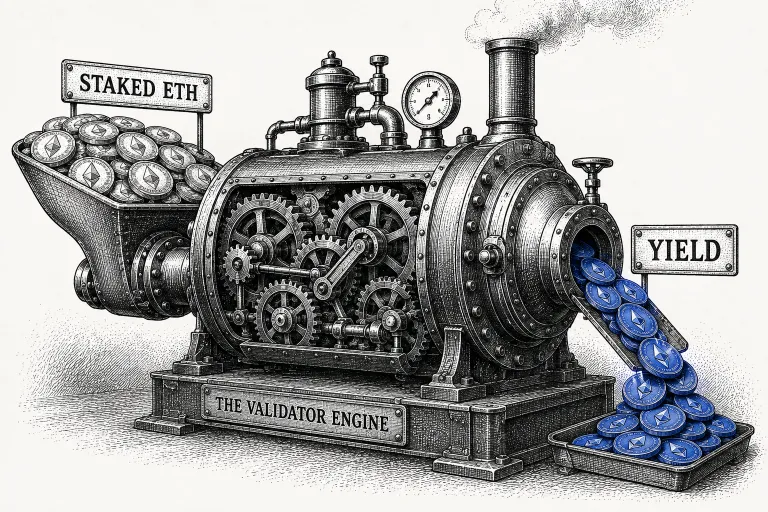
Here’s where the strategy gets genuinely interesting beyond pure accumulation. Roughly 85% of BitMine’s total ETH holdings, close to 4.9 million tokens, are actively staked through the company’s own validator infrastructure, called MAVAN, short for Made in America VAlidator Network. Not a passive holding strategy, an actively yield-generating one. That staking operation isn’t a rounding error either. At a recent 7-day annualized yield of roughly 2.67%, BitMine’s staking revenue runs around $247 million annually, with management projecting that figure could climb toward $290-291 million once the entire treasury gets routed through staking. The BitMine Ethereum Treasury effectively functions as a self-funding machine, buy ETH, stake it, use the yield to help fund further purchases, repeat weekly. Worth pausing on what makes this genuinely different from a typical corporate crypto play. Most companies dabbling in digital assets simply hold the token and hope the price goes up. The BitMine Ethereum Treasury does that too, obviously, but layers active yield generation directly on top, meaning the position isn’t purely a directional price bet, it’s closer to owning productive infrastructure that happens to also carry price exposure. That distinction matters a lot when analysts try to model what this treasury is actually worth beyond the raw token count.
Wall Street Took Notice, Literally
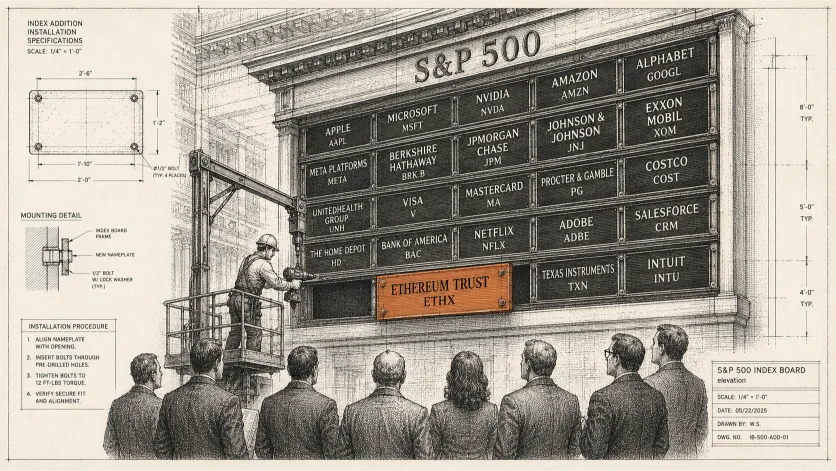
This isn’t just a crypto-forum curiosity anymore. BitMine’s stock, BMNR, got added to the Russell 1000 Large-cap index in late June 2026, a genuinely significant milestone for a company that was running mining rigs a year earlier. Tom Lee noted the inclusion could bring hundreds, potentially thousands, of new institutional equity holders into the stock, since passive index funds and ETFs tracking the Russell 1000 automatically rebalance to include newly qualifying companies. That’s a meaningful validation point. Getting added to a major institutional index isn’t something crypto-adjacent companies historically achieved easily, and it signals that traditional finance is increasingly comfortable treating a company built around the BitMine Ethereum Treasury as a legitimate, indexable equity, not a speculative sideshow.
How BitMine Stacks Up Against Bitcoin Treasury Companies
Corporate crypto treasuries aren’t new, Michael Saylor’s Strategy Inc. pioneered the concept with Bitcoin years ago, and still runs the largest single-asset crypto treasury among public companies with roughly 847,000 BTC. BitMine’s Ethereum-focused approach sits in a similar conceptual lane, hold a major crypto asset directly on the balance sheet, let public shareholders decide whether that exposure is a feature or a risk. But the comparison isn’t perfectly clean. Bitcoin treasury companies have a simple, well-understood narrative: they hold BTC purely for price exposure. ETH’s story is more layered. Ethereum functions as the base layer for DeFi, NFTs, stablecoins, and a huge share of on-chain economic activity, and it generates native staking yield that Bitcoin simply doesn’t offer. An investor in the BitMine Ethereum Treasury isn’t just betting on price appreciation, they’re getting exposure to network utility and staking economics simultaneously, a genuinely different value proposition than a pure Bitcoin treasury play. Scale-wise, the two companies now sit in comparable territory too, even if the underlying assets differ. Among publicly traded companies, only Strategy runs a larger single-asset crypto position than BitMine currently holds, which says something about how quickly this Ethereum-specific strategy scaled once it got underway. Thirteen months from launch to becoming the second-largest corporate crypto treasury anywhere is a genuinely fast climb.
What Could Go Wrong Here?
Worth being honest about the real risks rather than only celebrating the growth numbers. Concentrating a corporate balance sheet this heavily into a single volatile asset carries obvious downside exposure, ETH has traded well below its all-time highs during parts of this accumulation period, meaning the BitMine Ethereum Treasury has absorbed real, significant price swings along the way. Staking carries its own risk layer too, slashing penalties for validator misbehavior, and general smart contract or protocol risk tied to Ethereum’s proof-of-stake mechanics. And a single company holding nearly 5% of an entire asset’s supply raises legitimate questions about concentration risk, both for BitMine’s own shareholders and, more broadly, for what happens to Ethereum’s liquidity and price dynamics if that position were ever unwound quickly. A company holding millions of ETH doesn’t automatically create a permanent institutional trend, and the latest purchases alone don’t prove corporate Ethereum accumulation will keep accelerating market-wide.
Why This Matters Beyond BitMine Itself
Regardless of how BitMine’s specific bet plays out, the broader signal matters. A company building a treasury this large forces a genuinely useful question into the open: can ETH become a legitimate balance-sheet asset the way gold, treasuries, or even Bitcoin have for other companies, or does its more complex network-utility role make it fundamentally different territory? Anyone wanting to understand the underlying mechanics that make an ETH treasury strategy like this even possible, staking, validator economics, proof-of-stake security, can dig into Ethereum.org’s staking overview, which breaks down exactly how validators like BitMine’s MAVAN network earn and secure rewards at the protocol level. For readers who want to track the ongoing, week-by-week accumulation directly rather than relying on periodic news roundups, The Block’s markets coverage has stayed consistently on top of BitMine’s purchases as they happen.
The Bottom Line
The BitMine Ethereum Treasury remains one of the more genuinely unusual corporate finance stories running through crypto right now, a former mining infrastructure company that pivoted hard into becoming one of the largest single holders of ETH on the planet, staking most of it for yield, buying more every single week without pause, and recently earning a spot in a major institutional stock index along the way. Whether the “Alchemy of 5%” strategy proves visionary or overextended will depend entirely on how Ethereum’s price and utility evolve over the coming years, but the scale of the bet alone makes it worth watching closely. For more coverage on how institutional players are reshaping Ethereum’s ownership and infrastructure, keep exploring the archives over at Ethpublic.com.