Back in 2022, right after the Merge, Ethereum’s supply chart looked like it was on a diet, shrinking week after week, and crypto Twitter couldn’t stop talking about it. “Ultrasound money,” they called it, a cheeky nod to Bitcoin’s “sound money” branding, except somehow scarcer. Fast forward to 2026, and that chart has quietly reversed course. ETH’s total supply is actually growing again. So what happened? Turns out the real story of Ethereum Issuance and Staking is way more interesting, and way more honest, than a single catchy meme could ever capture. Let’s dig into how this thing actually works.
The Basics: Where New ETH Actually Comes From
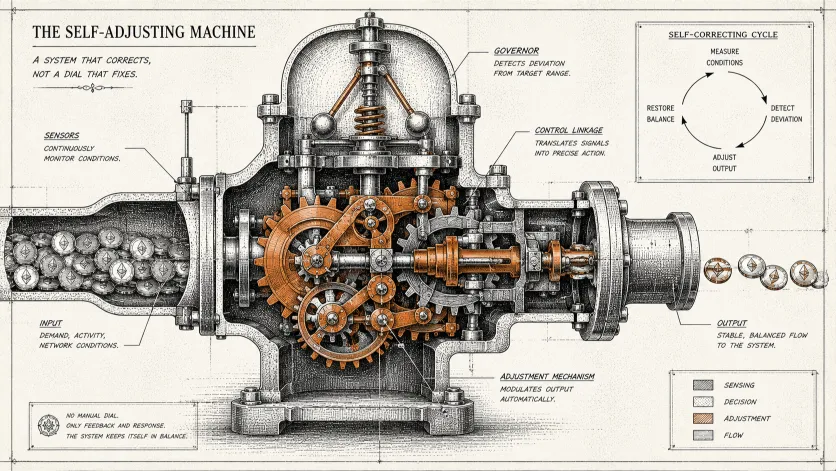
Every new ETH token in existence today gets created through one mechanism: staking rewards. Ethereum Issuance is the technical term for this process, new ETH minted by the protocol and paid out to validators who lock up capital to secure the network through Ethereum Staking. Unlike Bitcoin’s mining rewards, which shrink on a fixed, predictable halving schedule, Ethereum Issuance scales dynamically based on how much ETH is actually staked at any given moment. Here’s the intuitive version. More people participating in Ethereum Staking means more validators need paying, so total issuance rises. Fewer people staking means fewer validators, so issuance falls. It’s a self-adjusting system, not a fixed printing schedule, and that distinction matters more than it might seem at first glance.
Enter the Burn: Why Ethereum Isn’t Just About Issuance
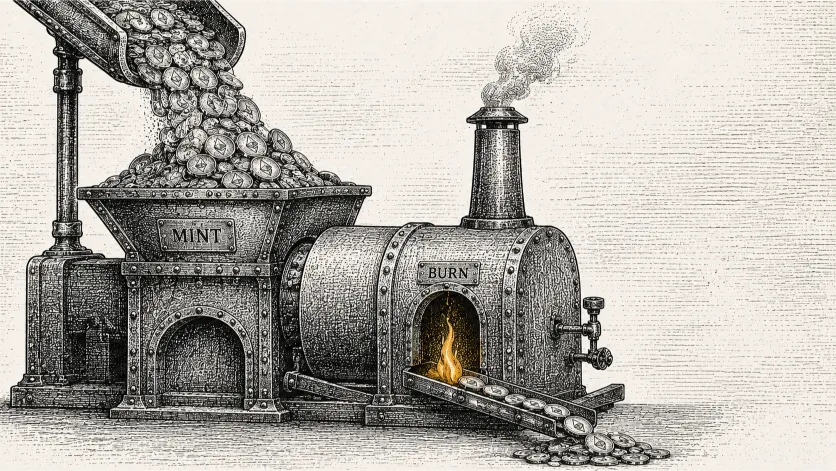
Issuance alone only tells half the story. Back in 2021, Ethereum introduced EIP-1559, a mechanism that permanently destroys a portion of every transaction fee instead of paying it to validators. That burned ETH disappears from circulation forever, creating a counterweight against new issuance. For roughly eighteen months after the 2022 Merge, that counterweight won decisively. Supply fell back toward and below the level it sat at during the Merge itself, with burns genuinely outpacing issuance, not hype, an accurate description of the actual data for that window. ETH really was getting scarcer, and the ultrasound money crowd had real numbers to point to.
Then Layer 2 Scaling Changed the Math
Here’s where the story gets genuinely interesting, and a little humbling for anyone who assumed deflation was permanent. Ethereum’s own scaling success ended up undercutting its burn rate. Ethereum’s scaling strategy pushes transactions off the expensive base layer onto Layer 2 rollups, networks like Arbitrum, Optimism, and Base, that process transactions cheaply and post compressed data back to Ethereum for security. That’s fantastic for users, cheap fees are genuinely good. But it starved the burn mechanism of fuel. Before the Dencun upgrade, Ethereum burned thousands of ETH per day during busy periods; after Dencun, daily burn dropped to as low as 50 to 70 ETH. Meanwhile, Ethereum Issuance kept flowing steadily to stakers regardless. With issuance running around 1,700 ETH per day and burn collapsing well below that, the equation flipped, Ethereum began creating more ETH than it destroyed. The mechanism that made ultrasound money real hadn’t been removed, it had simply been routed around.
So Is ETH Inflationary Now?
Technically, yes, mildly. As of April 2026, ETH’s net issuance sits at approximately 0.23% annual inflation, a real number worth sitting with. Worth immediately adding crucial context though, because raw numbers without comparison mislead people constantly. Ethereum still issues roughly 90% less ETH than it did under the old proof-of-work mining system, and compared to Bitcoin’s current inflation rate of around 0.8% annually on a fixed schedule, Ethereum’s net inflation in calmer periods actually runs lower. Read that again. Both major crypto assets are technically inflating right now, and by some honest measures, Ethereum inflates less than Bitcoin does. The “ultrasound money” claim survives in a narrower, more technical form, even without outright deflation. It’s just not the simple, triumphant story the 2022 meme implied.
The Staking Side of the Equation
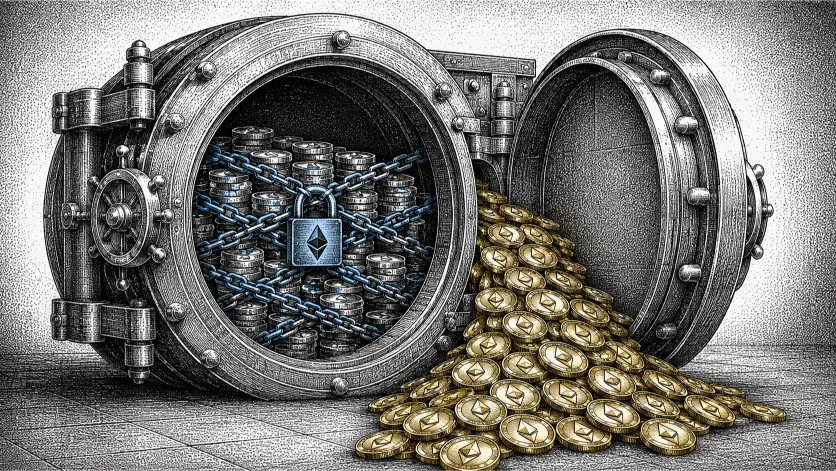
Here’s the piece that often gets lost when people focus purely on issuance and burn numbers. Ethereum Staking itself creates a separate kind of scarcity, entirely independent from whether the network is technically inflationary or deflationary in any given month. As of April 2026, approximately 36 to 37 million ETH, more than 30% of total supply, sits locked in staking contracts, illiquid, not sitting on exchanges, not available for casual day-to-day trading. That’s a genuinely enormous chunk of the total supply effectively taken off the market. This dual-pressure dynamic, staking locking up supply while burning simultaneously removes tokens from circulation, positions Ethereum as a uniquely structured asset, one where validators earn yield while the liquid, tradeable portion of supply keeps shrinking regardless of headline inflation numbers. Ethereum Staking and Ethereum Issuance work as two sides of the same coin, quite literally, one creates new tokens, the other locks a third of them away from ever touching an exchange order book. Worth understanding the mechanics a bit more too. Validators who commit ETH through Ethereum Staking aren’t just passively locking funds, they’re actively running software that validates transactions and proposes new blocks, earning rewards proportional to their stake and their uptime. Slack off or go offline too often, and penalties chip away at that stake instead. Ethereum Staking isn’t a free lunch, it’s compensation for genuinely useful, ongoing work securing the network around the clock.
What Actually Determines the Balance
Nobody sat down and picked these numbers arbitrarily. There’s a genuine design philosophy behind how Ethereum Issuance gets calibrated, and it directly depends on Ethereum Staking participation levels. The “correct” level of ETH issuance and burning is the one that balances network security, since validators genuinely need yield to justify locking up capital, user affordability, since transaction fees have to stay reasonably low, and store-of-value properties, since supply shouldn’t inflate excessively either. That’s a three-way balancing act, not a simple scarcity slider someone can crank to maximum. Push burn too high and fees become unaffordable for regular users. Push issuance too low and validators lose the economic incentive to secure the network properly. Ethereum’s protocol designers built a system that self-adjusts within safety limits rather than locking in one fixed outcome forever, and the network’s max annual inflation rate is actually capped at 1.5%, a built-in safeguard preventing runaway hyperinflation even in worst-case scenarios.
A Quick Word on Validator Economics
Worth pausing on what actually motivates someone to become a validator in the first place, since the whole system depends on enough people finding Ethereum Staking worthwhile. Current yields hover in a range most traditional investors would recognize as reasonable, not eye-popping, but competitive with other yield-generating assets, especially once you factor in that this yield comes from securing genuinely valuable infrastructure rather than pure financial engineering. Running a validator also carries real responsibility, uptime matters, honest behavior matters, and slashing penalties exist specifically to punish bad actors who try to game the system. That accountability is actually the point. New ETH isn’t handed out for free, it’s compensation tied directly to verifiable, ongoing work securing a multi-hundred-billion-dollar network. The economics only function because enough validators find the tradeoff worthwhile, and so far, with over thirty percent of supply locked in, plenty clearly do.
Does This Mean Ultrasound Money Was Wrong?
Not exactly wrong, just conditional, and honestly, that’s a more interesting story than either the hype cycle or the backlash gave it credit for. The ultrasound money thesis isn’t dead, it’s conditional, relying on Ethereum’s mainnet activity growing enough to push burn rates back above issuance again. If real-world asset tokenization, DeFi growth, or a fresh wave of institutional demand pushes serious activity back onto Ethereum’s base layer rather than Layer 2s, the burn could easily outpace Ethereum Issuance once more, flipping the network back toward deflation. Until then, the more accurate, less meme-friendly description is that Ethereum currently functions as a low-inflation asset rather than a strictly deflationary one, and there’s genuinely nothing wrong with that framing. Low, controlled, transparent inflation with a third of supply locked in productive Ethereum Staking is still a fundamentally different monetary story than most fiat currencies can tell.
Where to Dig Deeper
Anyone wanting to track these numbers in real time, issuance rates, burn totals, staking ratios, all update constantly, and watching them shift firsthand teaches you more than any single snapshot article ever could. Ethereum’s own developer documentation breaks down the mechanics of Ethereum Staking clearly at Ethereum.org’s proof-of-stake overview, covering exactly how validators earn rewards and how the Ethereum Issuance formula actually calculates payouts. For live, continuously updated supply data, Ultrasound.money’s dashboard remains the go-to source the entire community still checks obsessively, tracking the real-time tug-of-war between burn and issuance as it happens.
The Bottom Line
Ethereum Issuance and Staking together tell a far richer story than any single meme or headline number can capture on its own. Yes, ETH is technically inflating again, roughly 0.23% annually as of 2026, reversing the dramatic deflation of 2022 and 2023. But issuance remains a fraction of pre-Merge levels, staking has locked away nearly a third of total supply, and the entire system is deliberately designed to self-correct as network activity shifts over time. Ultrasound money isn’t dead, it’s just waiting for the conditions that made it briefly true to return. For more breakdowns on how Ethereum’s protocol economics actually work under the hood, keep exploring the archives over at Ethpublic.com.