


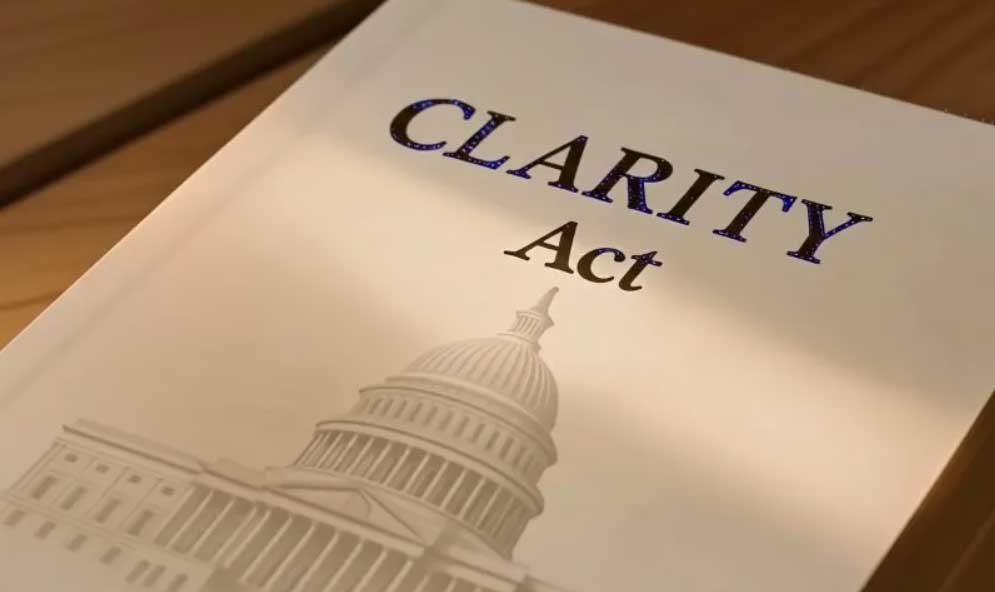
For years, the cryptocurrency industry in the United States has operated in a regulatory gray zone. Exchanges, token issuers, and investors have all struggled to understand which federal agency oversees what, and which rules apply to which digital assets. The Digital Asset Market CLARITY Act of 2025, commonly known as the CLARITY Act, represents the most ambitious congressional effort to date to resolve that confusion and establish a comprehensive regulatory framework for the multitrillion-dollar crypto market.
Why Crypto Needed a Market Structure Bill
Before the introduction of the CLARITY Act, the regulation of digital assets in the United States was shaped largely by enforcement actions rather than clear legislation. The Securities and Exchange Commission and the Commodity Futures Trading Commission both claimed overlapping jurisdiction over various tokens and trading platforms, leading to conflicting rulings, costly litigation, and widespread uncertainty. Companies that wanted to operate legally often had no clear path to compliance, and many chose to relocate their operations overseas to jurisdictions with more defined regulatory frameworks, such as the European Union under its Markets in Crypto-Assets regulation.
This regulatory vacuum also left consumers and investors exposed. Without clear rules governing how exchanges must segregate customer assets, manage conflicts of interest, or meet minimum capital requirements, the market remained vulnerable to the kind of catastrophic failures that had already cost retail investors billions of dollars. The crypto industry, along with many lawmakers on both sides of the aisle, recognized that the status quo was unsustainable.
How the CLARITY Act Took Shape in the House
On May 29, 2025, House Committee on Financial Services Chairman French Hill introduced the CLARITY Act as H.R. 3633. The bill was designed to draw a clear line between when a digital asset should be treated as a security under SEC jurisdiction and when it should be classified as a commodity regulated by the CFTC. It also created a formal registration process for digital commodity exchanges, brokers, dealers, and custodians, and it included consumer protections like disclosure requirements and conflict of interest safeguards.
One notable provision of the bill prohibited the Federal Reserve from issuing a central bank digital currency without explicit congressional authorization, reflecting bipartisan skepticism toward government-issued digital money. The House passed the CLARITY Act in July 2025 with a vote of 219 to 210, sending the bill to the Senate, where its journey would become significantly more complicated.
The Senate’s Rocky Path Forward
Because the bill touches on both securities and commodities law, the Senate split responsibility between two committees. The Senate Banking Committee, chaired by Tim Scott of South Carolina, took charge of provisions related to the SEC and the broader market structure. The Senate Agriculture Committee, chaired by John Boozman of Arkansas, handled the portions concerning CFTC oversight of digital commodities.
Throughout the second half of 2025, both committees worked on their own drafts of the legislation. Senator Scott and Subcommittee Chair Cynthia Lummis released a discussion draft in July 2025, followed by a more detailed 182-page version in September. The Senate Agriculture Committee released its own draft in November. Negotiations between Republicans and Democrats continued through the holiday recess, but the year ended without either committee advancing the bill to a vote.
January 2026: A Breakthrough and a Setback
The new year brought a burst of activity. Both committees had planned markup sessions for mid-January 2026, but the Senate Banking Committee postponed its session after more than 100 proposed amendments revealed deep divisions on several key issues. Chairman Scott chose to delay rather than risk a failed vote that could have derailed the legislation entirely.
The Senate Agriculture Committee fared better. On January 29, 2026, the committee advanced its version of the bill, known as the Digital Commodity Intermediaries Act, on a narrow 12-11 party-line vote. This marked the first time any crypto market structure bill had ever cleared a Senate committee, an important milestone for the industry even though the vote lacked bipartisan support. Chairman Boozman called it a critical step toward creating clear rules for digital asset markets while acknowledging that more work remained.

The Sticking Points Holding Up the CLARITY Act
Three major issues have dominated negotiations and continue to stand between the CLARITY Act and final passage. The first is stablecoin yields. The GENIUS Act, which Congress passed in 2025 to regulate stablecoin issuers, prohibits those issuers from paying interest on stablecoin balances. However, crypto exchanges like Coinbase have found ways to offer similar rewards through affiliate arrangements, and the banking industry has lobbied aggressively to close what it sees as a regulatory loophole. This dispute became so contentious that Coinbase CEO Brian Armstrong temporarily pulled his support for the Senate draft, contributing to the Banking Committee’s postponement.
The second issue involves decentralized finance, or DeFi. Lawmakers are wrestling with how to regulate protocols that operate without a central intermediary. Crypto advocates want to ensure that software developers who build DeFi tools are not held liable when bad actors misuse their technology, while law enforcement agencies want sufficient authority to pursue illicit finance through decentralized channels.
The third issue is ethics. Democrats have pushed for provisions that would prevent elected officials and their family members from profiting directly from cryptocurrency ventures while in office, a concern heightened by Trump-affiliated crypto projects that launched after the President took office. Ethics amendments proposed during the Agriculture Committee markup failed along party lines, and Democrats have signaled this issue must be addressed before they will support the final legislation.
Where the CLARITY Act Stands Today
As of February 2026, the CLARITY Act occupies a unique position. It has cleared the House and passed one of two required Senate committees. The Senate Banking Committee has yet to reschedule its markup, though the White House has stepped in to mediate between the banking industry and crypto companies on the stablecoin rewards dispute, with both sides reportedly working toward a resolution by the end of February.
If the Banking Committee can advance its version, the two Senate drafts would be combined into a single bill for a full Senate floor vote. A successful Senate vote would send the legislation back to the House for reconciliation, since the Senate version will differ from the one the House already passed. After that, the final bill would head to President Trump’s desk for signature.
When Is the CLARITY Act Likely to Pass?
Industry observers and analysts offer a range of timelines. The most optimistic scenario envisions the Senate Banking Committee resolving its disputes in late February or March, advancing a combined bill to the Senate floor in the spring, and sending a reconciled version to the President by summer 2026. This timeline aligns with the crypto industry’s stated preference to see the bill signed into law well before the November 2026 midterm elections.
A more cautious projection acknowledges that the stablecoin, DeFi, and ethics disputes could push meaningful progress into the summer, with a final vote not arriving until fall. This scenario remains plausible but carries risk, as midterm campaign pressures typically make it harder to advance complex legislation in the months leading up to an election.
The worst-case scenario is that partisan gridlock stalls the bill entirely, pushing comprehensive crypto regulation into the next Congress in January 2027. GovTrack currently assigns the CLARITY Act roughly a 30 percent chance of being enacted, reflecting both the genuine momentum behind the bill and the significant obstacles that remain. Prediction markets have also fluctuated, with odds declining after each delay and rebounding after each committee milestone.
What Passage Would Mean for the Crypto Industry
If signed into law, the CLARITY Act would represent a watershed moment for digital assets in the United States. Exchanges and trading platforms would finally have a clear registration pathway. Investors would benefit from mandatory disclosures, asset segregation requirements, and conflict of interest protections. The SEC and CFTC would each have well-defined jurisdictions, reducing the regulatory turf wars that have characterized the industry for years. Institutional capital, which has largely remained on the sidelines due to legal uncertainty, could flow into the market with greater confidence.
For now, the crypto industry watches and waits as the Senate navigates its remaining hurdles. The progress made since mid-2025 is undeniable, but the final stretch may prove to be the most challenging. Whether the CLARITY Act becomes law in 2026 or gets pushed to the next Congress will depend on whether lawmakers can find common ground on stablecoins, DeFi, and ethics before time runs out.
For a deeper look at how blockchain technology is reshaping wealth and investment strategy, explore our guide to cryptocurrency and digital asset trends. The full text of the CLARITY Act is available on Congress.gov, and the Senate Banking Committee published a detailed Myth vs. Fact breakdown addressing common misconceptions about the bill. Investors tracking the broader regulatory landscape may also want to read our coverage of emerging tech trends shaping 2026.
Check Out ethpublic home page