

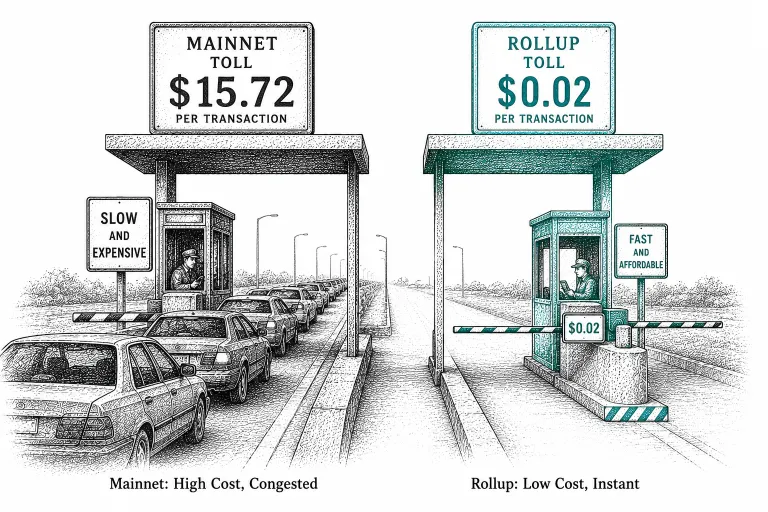
Remember paying forty dollars to swap twenty dollars worth of tokens? Yeah, everyone does, and nobody misses it. Back in 2021, sending a simple transaction on Ethereum could cost more than a nice dinner, and half the internet declared the network dead on arrival. Funny how that turned out. Ethereum didn’t die, it just got smarter about where the heavy lifting happens. Welcome to Ethereum Layer 2 Explained, the guide that untangles how a handful of clever side networks quietly rescued Ethereum from its own popularity.
First, What’s the Actual Problem Layer 2 Solves?
Ethereum’s base layer, often called Layer 1 or mainnet, processes every transaction through thousands of independent nodes worldwide. Great for security. Terrible for speed, since every single node has to verify every single transaction. That bottleneck used to mean maybe fifteen transactions per second network-wide, which sounds fine until millions of people show up wanting to trade, mint, and lend all at once. Enter Ethereum Layer 2, a category of networks built on top of Ethereum rather than replacing it. Layer 2 chains handle the bulk of transaction processing off the main network, then bundle the results back to Ethereum for final settlement. Ethereum stays the secure foundation. Everyday activity moves somewhere faster and cheaper. Simple concept, surprisingly complicated engineering underneath it.
How Rollups Actually Work
Most Ethereum Layer 2 networks today are what’s called rollups, and understanding rollups is basically understanding the whole scaling story. A rollup executes transactions off-chain, batches thousands of them together, and posts a compressed summary back to Ethereum mainnet. Ethereum doesn’t need to redo all that computation itself, just verify that everything checks out. Two competing rollup designs currently split the market. Optimistic rollups assume transactions are valid by default and rely on a challenge window where anyone can flag fraud after the fact. An optimistic rollup batches thousands of transactions offchain, posts them to Ethereum, and assumes they’re valid unless someone proves otherwise during that challenge period, trading simpler technology for a slower withdrawal process. Arbitrum and Optimism built their reputations on this model. ZK rollups take the opposite bet, generating a cryptographic proof that a batch of transactions is valid before ever posting it to Ethereum. No waiting period, no assuming good faith, math settles it instantly. Both approaches solve the same core problem from different angles, and the debate over which wins long-term keeps developer forums busy at 2am.
Why Everyone Moved There Basically Overnight
The shift wasn’t gradual, it was a stampede. Layer 2 rollups have absorbed the vast majority of activity that used to clog Ethereum mainnet, with Base, Arbitrum, Optimism, zkSync, Linea, Scroll, and a long tail of newer chains together carrying roughly 85% of Ethereum-related transaction volume. Mainnet itself increasingly functions as a settlement layer rather than the place regular people actually transact. That’s not a small pivot. Layer 2 blockchains currently process more transactions than Ethereum mainnet itself, marking a real shift in how blockchain scalability gets addressed. Ask an average DeFi user today which network they’re actually clicking around on, and there’s a solid chance the honest answer is Base or Arbitrum, not Ethereum directly, even though every one of those transactions ultimately settles back to Ethereum’s base layer for security.
The Upgrade That Made It All Cheap
None of this scales without cheaper data storage, and that’s where proto-danksharding enters the story. Blob transactions, priced specifically for rollup calldata, cost far less than legacy calldata pricing, keeping Layer 1 base fee pressure low even as usage scaled dramatically. Translation: Ethereum built a cheaper mailing service specifically for Layer 2 chains to send their transaction summaries home. The results speak for themselves. Everyday on-chain actions like swaps, NFT mints, and micro-payments now cost cents or less on Layer 2 networks, while Layer 1 gets preserved for settlement, governance, and high-assurance state transitions. That’s the entire Ethereum Layer 2 pitch in one sentence: keep the expensive, maximally secure layer for what truly needs it, push everything else somewhere faster and dramatically cheaper.
Layer 2 Isn’t Just for Swaps and NFTs Anymore
Here’s what surprised even longtime crypto watchers: the applications built on top kept getting more ambitious once fees dropped. Gaming projects that couldn’t survive five-dollar transaction costs suddenly became viable. Micropayment experiments that made zero economic sense on mainnet started actually working. Institutional players began exploring tokenized assets and settlement flows on Ethereum Layer 2 rails specifically because the cost math finally penciled out. Developer tooling matured right alongside the applications. Developers can deploy Solidity or Vyper smart contracts on most Layer 2 networks without rewriting code, relying on familiar tool stacks like MetaMask, Foundry, and The Graph. That compatibility mattered enormously. Nobody wants to learn an entirely new development stack just because their app moved to a faster chain, and the fact that most Ethereum Layer 2 networks stayed EVM-compatible kept the transition relatively painless for builders. DeFi liquidity tells the clearest version of this story. Ethereum still houses the majority of DeFi liquidity, well above 60% of the total market, alongside a very large share of global stablecoin activity, even as capital slowly migrates outward toward rollup ecosystems. That split isn’t a contradiction, it’s the whole point. Ethereum mainnet anchors the value while Ethereum Layer 2 networks handle the day-to-day churn of trading, lending, and swapping that would otherwise clog up the base chain.
Okay, But What’s the Catch?
No free lunch here, honestly. Layer 2 scaling introduced its own set of tradeoffs worth understanding before diving in headfirst. Many Layer 2 networks still rely on centralized sequencers for transaction ordering, a real centralization risk that runs counter to Ethereum’s core decentralization ethos. A single sequencer going offline, or worse, misbehaving, can disrupt an entire network’s activity temporarily. Withdrawal times have improved but haven’t fully disappeared as a friction point either. Optimistic rollups historically required waiting days to move funds back to mainnet during the fraud-proof challenge window, though liquidity-based instant withdrawal mechanisms and fraud-proof acceleration have reduced those exit times from days down to minutes in many cases. Fragmentation is another genuine headache. Liquidity, users, and even simple wallet balances get scattered across a dozen different Layer 2 networks, and bridging assets between them still isn’t always the seamless experience marketing materials promise.
Where’s This All Heading?
Full danksharding looms as the next major milestone, promising to push data availability even further and make room for exponentially more Layer 2 activity down the line. Beyond that, expect account abstraction and embedded wallets to keep smoothing out the rough edges, letting people interact with apps built on Ethereum Layer 2 networks without ever thinking about gas tokens, bridge mechanics, or seed phrases at all. The goal, according to industry watchers, is getting users to interact with Layer 2 apps without even knowing what a seed phrase or gas fee means, which sounds ambitious until you remember how far the ecosystem has already come from the forty-dollar-swap era. Layer 3 networks are also entering the conversation, essentially specialized chains built on top of existing Layer 2 rollups for niche use cases like gaming or high-frequency trading. Whether that additional layer of abstraction becomes standard or ends up as a temporary detour remains genuinely unclear. Ethereum’s roadmap keeps evolving faster than most explainer articles can keep pace with, this one included. Modular data availability is quietly reshaping the picture too. Some rollups now lean on external DA providers rather than posting every byte back to Ethereum mainnet, trading a sliver of security assumptions for even cheaper throughput. Purists worry that pulls value away from Ethereum’s base layer over time. Pragmatists counter that a thriving Ethereum Layer 2 ecosystem, regardless of exactly where the data lives, still ultimately strengthens the network’s relevance. Reasonable people disagree, and that tension probably won’t resolve cleanly any time soon.
Ethereum Layer 2 Explained: The Bottom Line
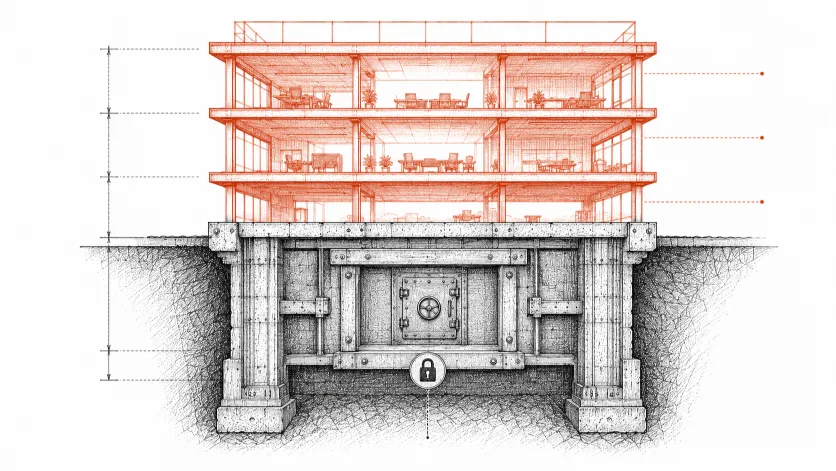
Ethereum Layer 2 solved a problem that genuinely threatened to sink the network’s usability just a few years back, and it did so without asking users to abandon Ethereum’s security guarantees or its enormous existing ecosystem. Rollups batch, compress, and settle, mainnet verifies and secures, and the whole system somehow works better distributed across multiple layers than it ever did crammed onto one. Not a perfect system yet, centralized sequencers and fragmented liquidity still need real solutions, but a dramatically better one than what existed before. Readers wanting the technical deep dive straight from the source should check out Ethereum.org’s Layer 2 overview, and anyone comparing specific rollup architectures might find L2Beat’s independent risk analysis genuinely useful before committing serious funds to any single network.
For more breakdowns on how Ethereum’s scaling ecosystem keeps evolving, keep exploring the archives over at Ethpublic.com.