

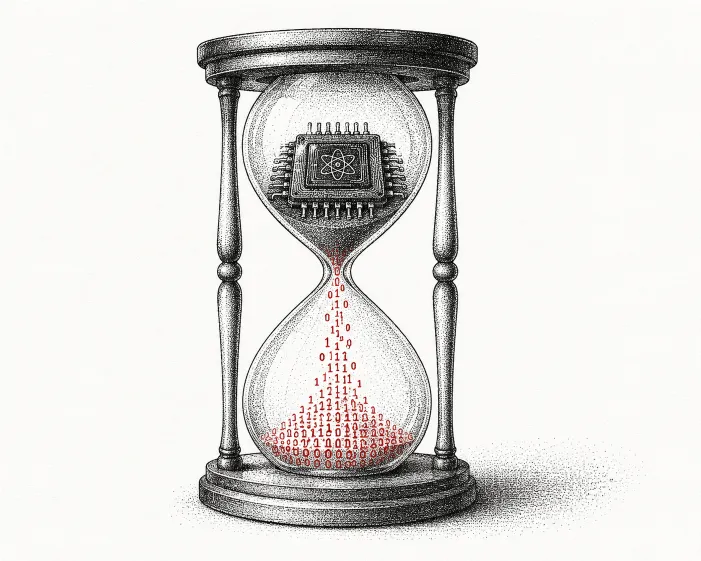
Picture this: a machine cold enough to make deep space look balmy, humming away in a lab somewhere, quietly chewing through math problems that would take your laptop longer than the age of the universe to solve. Sounds like science fiction, right? Except it’s not. Quantum computers are real, they’re getting stronger every year, and a growing chorus of cryptographers is asking the uncomfortable question: can quantum computers break Ethereum? Grab a coffee, because we’re about to dig into this one properly.
So, What’s the Actual Worry Here?
Ethereum, like most blockchains, leans hard on a type of cryptography called elliptic curve cryptography, or ECDSA if you want to sound fancy at a dinner party. Your wallet’s private key generates a public key through a one-way mathematical trapdoor. Easy to compute forward, brutally hard to reverse. Classical computers, even the biggest supercomputers on Earth, would take longer than several universe-lifetimes to crack a single private key by brute force.
Quantum computers don’t play by the same rules. A sufficiently powerful quantum machine running Shor’s algorithm could, in theory, reverse that trapdoor function in a fraction of the time. That’s the entire ballgame. Not mining faster, not spamming the network, but literally deriving someone’s private key from their public key. Suddenly the question of whether quantum computers break Ethereum stops sounding like nerdy speculation and starts sounding like a legitimate security roadmap item, which, spoiler alert, it now is.
How Close Are We, Really?
Whether quantum computers break Ethereum any time soon comes down almost entirely to hardware, and here’s where a lot of clickbait headlines go off the rails. Today’s quantum computers, the ones from IBM, Google, and a handful of well-funded startups, have somewhere in the range of a few hundred to a couple thousand physical qubits. Breaking a 256-bit elliptic curve key is estimated to require millions of high-quality, error-corrected logical qubits running for days. We are nowhere close to that yet. Researchers generally peg a realistic timeline somewhere between ten and twenty-five years out, though nobody has a crystal ball and breakthroughs in quantum error correction could shrink that window overnight.
Honestly, though, waiting until the threat is imminent would be a terrible strategy. Ethereum’s own leadership seems to agree. According to a draft proposal from Vitalik Buterin, account abstraction and hash-based or lattice signatures are being explored as a path toward quantum resistance, with a realistic horizon around 2029. That’s not panic. That’s planning ahead while there’s still runway.
Why “Harvest Now, Decrypt Later” Changes the Calculus
Wondering if quantum computers break Ethereum only matters the day the hardware exists? Not quite, and here’s the part that keeps security researchers up at night. An attacker doesn’t need a working quantum computer today to start causing damage. Bad actors can simply record public blockchain data now and sit on it, waiting for the hardware to catch up. Once a machine capable of running Shor’s algorithm at scale exists, all that harvested public key data becomes fair game retroactively. For Ethereum specifically, this mostly threatens exposed public keys, which happen whenever you send a transaction from an address (your public key becomes visible on-chain the moment you sign something). Dormant wallets that have never sent a transaction are safer, since only the hashed address is public, not the raw public key itself. Funny enough, that means some of the oldest, most inactive wallets on the network, including a chunk of the coins tied to Ethereum’s earliest days, are technically better protected than accounts that transact regularly.
What Is Ethereum Actually Doing About This?
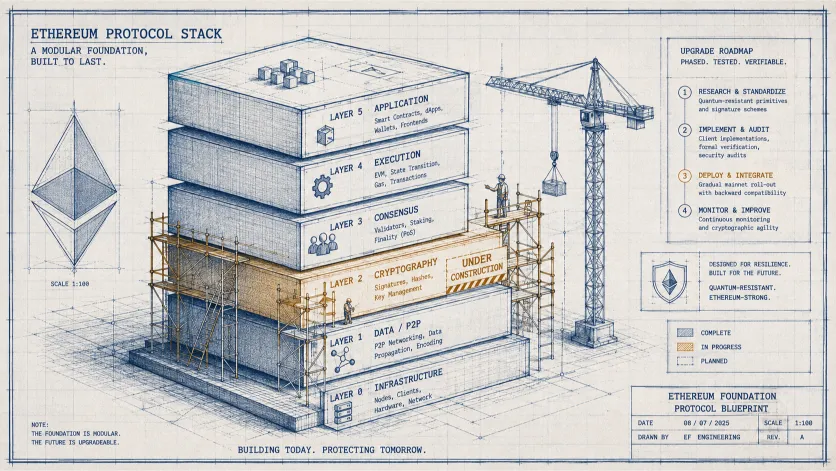
Good news: the possibility that quantum computers break Ethereum isn’t a problem nobody’s tackling. The Ethereum Foundation has been increasingly vocal about quantum defense over the past year. Buterin’s “Lean Ethereum” initiative, a roadmap spanning 2026 through 2029, elevates quantum defense as a significant priority, with immediate focus on quantum-resistant blob architecture. That’s a mouthful, but the short version is that engineers are rebuilding the pipes before the water pressure becomes a problem. The broader roadmap flags several cryptographic systems Ethereum currently relies on, including BLS signatures, KZG commitments, and ECDSA, as candidates for eventual replacement with post-quantum alternatives. Translation: nearly every cryptographic building block of the network is getting a quantum-safe makeover, not just wallet signatures. Slow and methodical describes the process well, and honestly, that’s exactly how you’d want a multi-hundred-billion-dollar network to handle something this foundational. Move fast and break things works for a social media app. Ledgers holding people’s life savings demand a different pace entirely.
What About Other Chains? Are They Ahead of Ethereum?
Nobody’s cracked the quantum computers break Ethereum question faster than Ethereum itself, and honestly, not really, no. Most large chains are aware of the quantum problem and have committed to addressing it, but their defenses currently live in planning documents rather than on mainnet. Ripple’s XRP Ledger has laid out a more concrete timeline targeting a full post-quantum transition by 2028. Bitcoin’s community is having similar debates, though arguably with even less consensus given the network’s more conservative governance culture. So no, Ethereum isn’t lagging behind some quantum-proof rival chain that’s already solved the problem. Everyone’s racing the same clock, just at slightly different paces.
Should You Actually Panic?
Short answer: nope. Longer answer: stay informed, but don’t lose sleep over it tonight. Fear that quantum computers break Ethereum tomorrow morning is measured in years, possibly a couple decades, not headlines, and Ethereum’s core developers are already knee-deep in solutions. The bigger practical risk right now isn’t quantum hackers, it’s the same old stuff: phishing scams, careless seed phrase storage, and shady smart contracts. Save your paranoia for those.
That said, a little healthy awareness goes a long way. If you’re holding significant assets long-term, it’s worth keeping an eye on Ethereum’s quantum-resistance rollout and being ready to migrate to new signature standards once they go live. Cold storage, hardware wallets, and avoiding unnecessary public key exposure are all sensible habits regardless of quantum risk, so building them now costs you nothing and pays off either way. Practically speaking, most everyday holders don’t need to do anything differently today. Watch the news, keep your seed phrase offline, and treat quantum resistance the way you’d treat a distant weather forecast: worth checking occasionally, not worth building a bunker over. Developers and protocol teams carry the heavier lift here, and by most accounts, they’re carrying it well.
A Quick Word on Smart Contracts and DeFi
Wallet keys get most of the spotlight in this conversation, but they’re not the only piece worth thinking about. Smart contracts, oracles, and the multisig setups guarding billions in DeFi liquidity all lean on the same underlying signature schemes. A world where quantum computers break Ethereum’s cryptography wholesale would ripple far past individual wallets, touching lending protocols, DEXs, bridges, and the custody arrangements institutions rely on. That’s part of why the Foundation’s approach treats this as a protocol-level problem rather than a wallet-level patch. Fixing one corner and leaving the rest exposed wouldn’t actually solve anything. Developers building on Ethereum today don’t need to rewrite their contracts in a panic. Standards bodies and core researchers are working out migration paths that, ideally, feel closer to a routine upgrade than a scramble. Account abstraction, in particular, opens the door to swapping signature schemes without forcing every single user to manually migrate funds to a brand-new address format. Clever engineering, basically, buying everyone breathing room.
How Does This Compare to Traditional Finance?
Banks, governments, and payment networks face the exact same quantum dilemma, by the way, just with less public visibility. RSA and ECC encryption secure everything from online banking to military communications, and NIST finalized its first post-quantum encryption standards back in 2024, giving the broader tech industry a concrete blueprint to migrate toward. Ethereum isn’t operating in a vacuum here. Cloud providers, browsers, and financial institutions are all racing the same clock, quietly rotating cryptographic foundations behind the scenes long before most users notice a thing. Crypto just happens to be more transparent about the process, since roadmaps and GitHub discussions play out in public rather than behind closed doors.
The Bottom Line
So, do quantum computers break Ethereum right now? Not today, not next year, and probably not for a good while yet. But the honest answer isn’t a flat no either, it’s “not yet, and the network knows it.” Ethereum’s engineers aren’t waiting around for a crisis; they’re rebuilding cryptographic foundations years ahead of the actual threat, which is precisely the kind of foresight you want from infrastructure securing hundreds of billions of dollars in value. Curious readers can dig deeper into the technical fundamentals over at Ethereum.org’s developer documentation, or check out ongoing research from NIST’s post-quantum cryptography standards for the broader picture of how the internet at large is preparing for the quantum shift.
For more breakdowns like this one on where crypto security is headed, keep exploring the archives over at Ethpublic.com.