
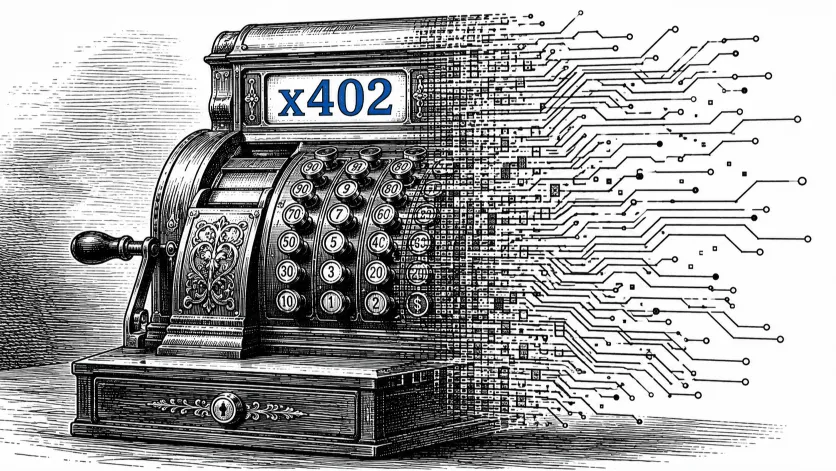
Coinbase x402: The Protocol That Finally Gives the Internet a Way to Pay
For more than three decades, the internet has had a dormant feature hiding in plain sight. HTTP status code 402 — “Payment Required” — was reserved by the architects of the web back in the 1990s, a placeholder for a future where payments could flow as seamlessly as data. That future never arrived. Until now. Coinbase x402 has launched, an open payment protocol that breathes life into that forgotten status code and, in doing so, may fundamentally reshape how money moves online — particularly in the emerging economy where AI agents, not humans, are doing the spending.
The Problem x402 Solves
The internet was built on a paradox. Data moves at the speed of light, but money still crawls through infrastructure designed before the web existed. Credit card networks charge merchants between two and three percent per transaction with minimum fees that make micropayments impossible. Accepting payments requires merchant accounts, compliance paperwork, subscription management systems, and layers of middlemen who each take a cut. For developers building APIs, the monetization options have been limited to awkward workarounds: API keys, tiered subscription plans, prepaid credit bundles, and manual invoicing cycles that belong in the fax machine era.
This friction has real consequences. Countless APIs and digital services that could be monetized on a per-use basis are instead given away for free or locked behind subscription walls that deter casual users. A developer who builds a weather API, a translation service, or a data feed has no simple way to charge a penny per request. The minimum viable price point that traditional payment rails can support is typically thirty cents per transaction, making microtransactions economically absurd.
The rise of AI agents compounds the problem exponentially. Autonomous systems that need to purchase compute time, access data feeds, call third-party APIs, and pay for services in real time cannot pull out a credit card. They cannot fill in billing forms. They cannot manage subscription accounts. The entire payment infrastructure that exists today was designed by humans, for humans, and it breaks completely when machines need to transact. Coinbase x402 directly addresses this gap.
How x402 Works
The elegance of x402 lies in its simplicity. It works within the existing HTTP protocol that already powers every interaction on the web. When a client, whether a browser, an application, or an AI agent, requests a resource from a server that requires payment, the server responds with an HTTP 402 Payment Required status code. Embedded in that response are the payment details: the price, the accepted token (typically USDC or another stablecoin), the recipient address, and an expiration time.
The client then signs a payment payload using cryptographic standards (EIP-712 for Ethereum-compatible networks) and resends the request with a payment signature header attached. A facilitator, which can be Coinbase’s hosted service or any third-party implementation, verifies the payment, settles the transaction on-chain, and the server delivers the requested resource. The entire cycle completes in roughly one second.
For developers implementing x402 on the server side, the integration is remarkably lightweight. A few lines of middleware added to an Express.js, Next.js, or Hono application can gate any endpoint behind a payment requirement. The Coinbase x402 developer platform provides reference SDKs in both TypeScript and Go, along with a hosted facilitator service that offers a free tier of one thousand transactions per month before charging a tenth of a cent per transaction thereafter.
On the client side, libraries for both browser and Node.js environments handle the payment signing automatically. An AI agent equipped with a compatible wallet can navigate x402-gated services without any human intervention, discovering the price, authorizing the payment, and consuming the resource in a single programmatic flow.

The Architecture of an Agentic Economy Powered by x402
What makes Coinbase x402 genuinely significant is not the technical plumbing, it is the economic model it enables. The protocol effectively transforms every API endpoint, every digital service, and every piece of premium content into a pay-per-use resource accessible to both humans and machines.
Consider the implications. An AI research agent can autonomously purchase real-time market data, satellite imagery, or specialized compute resources as needed, paying fractions of a cent per request. A content platform can charge readers a nickel to read a single article without requiring account creation or a monthly subscription. A developer can monetize a niche API serving a few hundred requests per day at price points that would be impossible with credit card infrastructure.
The protocol’s scheme system adds further flexibility. The initial “exact” scheme handles fixed-price transactions, pay one dollar to access this endpoint. But the architecture supports additional schemes like “upto,” where a client authorizes a maximum spend and is charged based on actual resource consumption, much like a metered utility. This opens the door for pay-per-token language model access, pay-per-minute compute billing, and other usage-based models that align cost precisely with value delivered under the Coinbase x402 framework.
The Ecosystem Around x402
Coinbase x402 is not a closed system. The protocol is open source under an Apache 2.0 license, and the ecosystem forming around it includes major infrastructure players.
Cloudflare has partnered with Coinbase to establish the x402 Foundation, a governance body dedicated to driving adoption of the protocol as a neutral standard. Stripe has announced previews of machine payments leveraging the protocol on modern blockchain networks. AI companies are integrating it so autonomous systems can discover, retrieve, and pay for tools dynamically.
The protocol has reportedly processed tens of millions of transactions to date, signaling that Coinbase x402 is moving beyond theory into real-world usage.
Why x402 Works Now
Earlier attempts at internet-native micropayments failed for practical reasons. Volatile cryptocurrencies made pricing unreliable. Transaction fees on older networks could exceed the value of the payment itself. Infrastructure was not mature enough.
Three developments have converged to make x402 viable today. First, stablecoins provide a predictable unit of value. Second, modern blockchain networks have driven transaction costs down to fractions of a cent with fast settlement times. Third, the explosion of AI agents has created urgent demand for machine-to-machine payment infrastructure that did not exist just a few years ago.

What x402 Means for the Future
The internet’s original flaw, the absence of a native payment layer, forced business models to rely heavily on advertising, data harvesting, and subscription bundling. Coinbase x402 introduces a new architecture where value flows as natively as information.
For developers, Coinbase x402 enables any API, data service, or digital resource to be monetized on a per-use basis with minimal overhead. For enterprises deploying AI agents, it provides a transactional backbone for autonomous systems that need to spend money at machine speed with verifiable settlement.
If Coinbase x402 achieves widespread adoption, the web may finally complete the circuit envisioned decades ago, where requesting data and transferring value become a single action executed in milliseconds through a simple HTTP interaction.
The 402 status code waited thirty years for relevance. With Coinbase x402, that moment may have arrived.
Check out the Coinbase x402 documentation for the full technical spec.
Read more Ethereum breakdowns like this one at ethpublic.com.